Nandita Dinesh: From Immersive Theatre to running a Writers' Workshop at SALA 2026


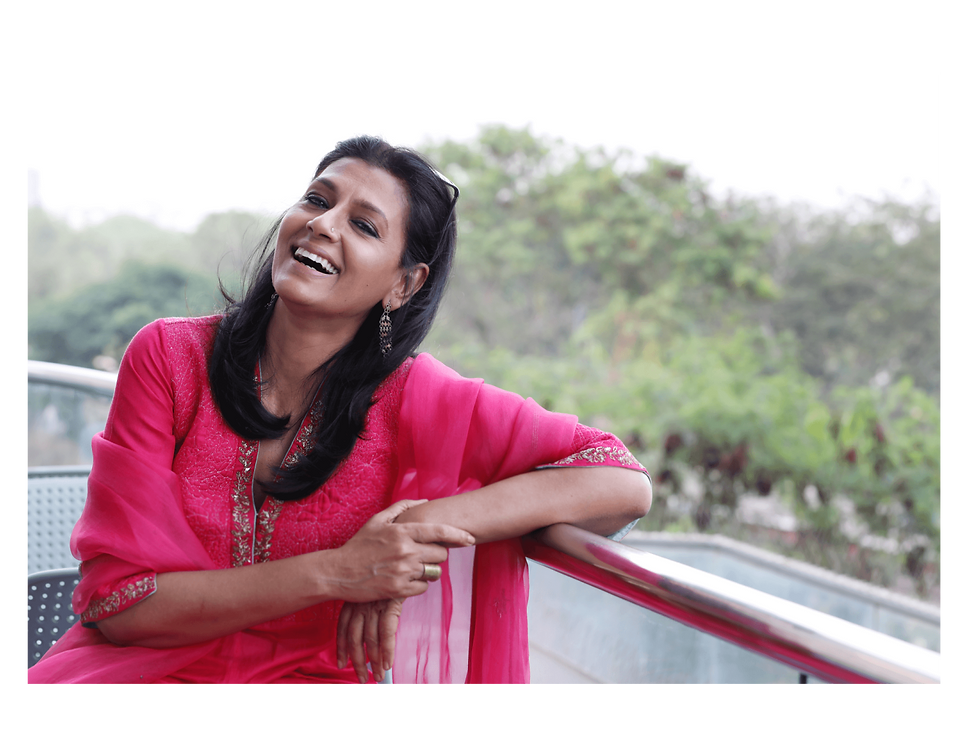
SALA’s 2026 Writer’s Workshop draws on Nandita Dinesh’s theater background to explore how writing on the page can come alive when spoken rather than just read aloud. I spoke with Nandita before the festival about her experiences and journey.
From Coimbatore to Pune, and on to Wellesley College
Nandita Dinesh grew up in Coimbatore, in Tamil Nadu — by her own description, "a small-town girl" in what was then a small town. She first moved out of Coimbatore to the Pune area to attend a United World College campus, and that experience “opened the door to so much of the rest of my life globally.” A scholarship led her to Wellesley College, where she first encountered theatre, specifically became interested in the role the arts could play in times and places of conflict, and then went on to obtain an MA in Performance Studies from the Tisch School of the Arts at New York University.
Immersive theatre: Rwanda to Kashmir to Doctoral Work
That interest took her first to northern Uganda and then to Rwanda before her PhD work at the University of Cape Town, South Africa, and it became the center of her doctoral research: "Performances, Perspectives, and Possibilities in Kashmir" examined whether a form called immersive theatre could open cross-community conversation between polarized groups. The project led to a 24-hour immersive piece in which audience members lived alongside the ensemble for a full day, moving through different perspectives and narratives from the Kashmir Valley. As an example of immersive theatre, Dinesh spoke of the Ram Leela as “one of the oldest forms of immersive theatre in India.”
Dinesh came to love teaching after returning to India from Rwanda. To bring more structure to the work in Kashmir, she pursued a PhD at the University of Cape Town while still based in India and teaching full time; Cape Town didn't have a distance program at the time; but the university agreed to let her do her fieldwork from the subcontinent and travel to Cape Town only at the end, for four months, to write up her dissertation.
The Risks of Life as a Dramaturg
Back in the U.S. with her PhD in hand, she kept teaching (at the United World College in Santa Fe, New Mexico) while continuing work on the Kashmir project, and kept running into censorship. Eventually the risk became serious enough, and because her ensemble was made up largely of Kashmiris (the youngest just 16), that she wasn't willing to keep exposing them to consequences she herself could leave behind. That was the turning point that pushed her toward writing as her primary practice, a shift she describes not as risk-free, but as one where the risk, at least, is hers to own.

Getting into Writing, Publishing
Writing started for Dinesh almost by necessity, through her PhD. Academic journal articles that she went on to write kept breaking form: rules-based academic writing felt claustrophobic to her. One project from this period, The Chronicles from Kashmir, was published as a multimedia textbook. Around 2017–2018, as censorship pressure on her theatre work intensified, she began writing fiction as well. Her first novel was picked up by Melville House in New York and published in 2022; she's since published creative-writing-oriented textbooks with Routledge, and her next novel is due out next year. She describes herself now as someone who writes across genres rather than settling into one, using each book to work through a different question and then following wherever that leads.
Teaching in Carceral Spaces
The shift into carceral spaces came alongside the writing pivot: in New Mexico she worked in juvenile detention centers in Albuquerque, asking what role creativity has in institutions built to shut it down. After the move to the San Francisco Bay Area in 2021, she taught briefly at University High School in San Francisco before becoming Dean of Academics at Mount Tamalpais College, which offers an associate of arts degree to incarcerated students inside San Quentin State Prison. She left that role around 2024, wanting to write and teach full time on her own terms, and began asking what it would mean to teach outside institutional structures altogether. That led her to start running writing workshops — first online, then in person at restaurants and cafés around the Bay Area, testing formats to find her audience.
Connecting with the SALA Organizers
The SALA connection came out of a chance conversation in Singapore in 2024, where her brother had recently moved. She'd reached out to the Indian Women's Association of Singapore to do a reading from her novel, and at that event met someone who asked if she'd heard of SALA and put her in touch with Kiran Malhotra and Ambika Sahay. Dinesh proposed one-on-one workshop slots at the festival itself. Seven or eight people signed up, and she was struck by how much people — many of them engineers, doctors, and lawyers writing as a hobby — wanted simply to talk with a fellow South Asian writer about the writing and publishing journey.
That response is what led to this year's cohort-based Writer's Workshop program (Bay Area's SALA Offers Literary Workshop For New Writers). The participants of the six-month program met as a group once a month, with sessions focused partly on presentation and performance skills, drawing on Dinesh’s theatre background to explore how writing on the page can come alive when spoken rather than just read aloud. Alongside the group sessions, she meets one-on-one with each writer, recognizing that writing goals are highly individual — some aim to write a literary bestseller, others simply need to write regardless of whether it's ever published. This year’s cohort was capped at nine, and Dinesh has met individually with each writer six times over the six months.
Who Participated, and What Are They Writing?
This first cohort spans a wide range of ages, professions, and genres. Participants include, a longtime dance artist; someone with a film background; someone whose day job is in law who's writing a memoir about his family's experience during Partition; someone in tech who is also a visual and literary artist working on fables; and a medical professional who writes poetry. Across the group, the work itself covers fiction, short stories, a screenplay, poetry, dance drama, and analytical nonfiction — as Nandita put it, "the whole gamut." Goals have shifted organically over the six months: Dinesh describes her role less as instructor and more as a witness to each person's individual trajectory.
The Writer Cohort presented at SALA 2026 on Saturday 9/26 from 12:30–1:30 p.m.
This article was published in India Currents on Sept 25, 2026.


Comments